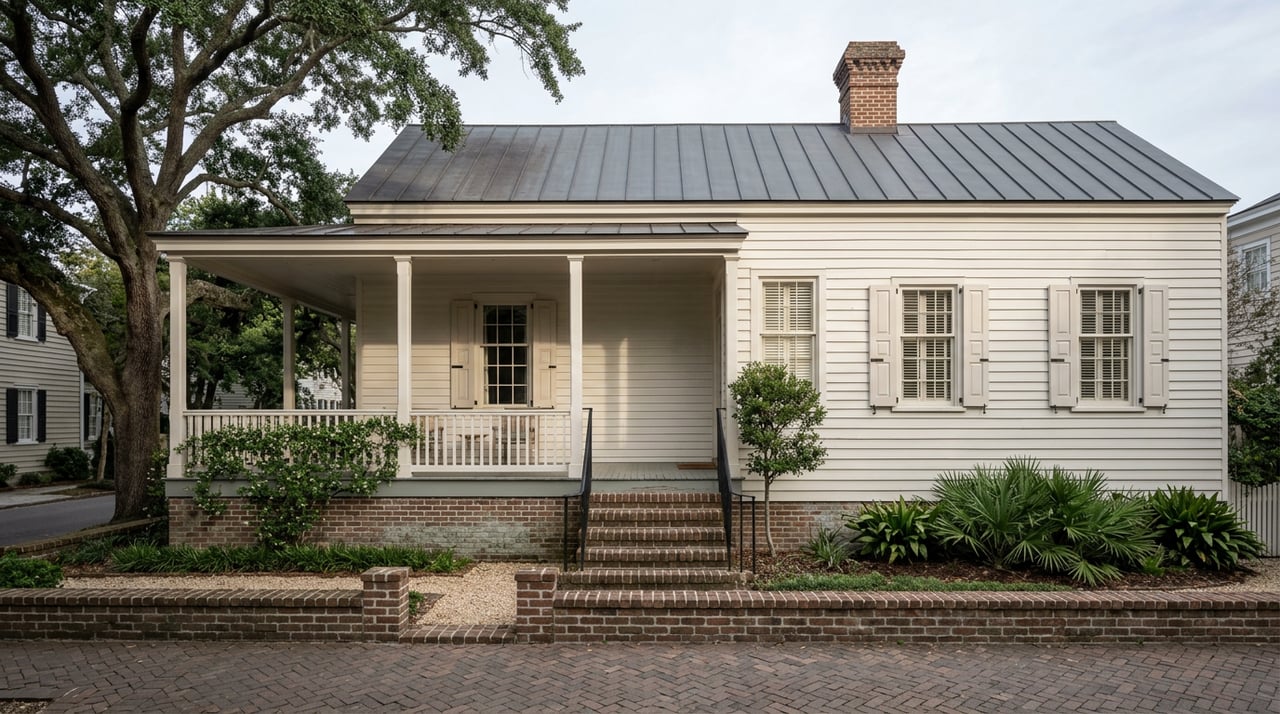
"Today's buyer wants everything perfect and new," a Charleston broker told the Post and Courier earlier this year, describing a demand for new wiring, plumbing, and HVAC systems inside historic shells.
That is a reasonable thing to want in 2026. Charleston-area price per square foot climbed to $1,600 to $1,900 in the first quarter of 2026, up roughly $100 from the same period a year earlier, and downtown Charleston alone saw 53 closings above $2 million in the first three months of the year, up from 32 in the same window in 2025. But on the Charleston peninsula, "perfect and new" runs into a problem most buyers don't discover until they're already under contract: the house doesn't answer to just one authority. It may answer to two, and only one of them shows up on a title report.
The Approval Everyone Knows About
The one buyers hear about is the City of Charleston Board of Architectural Review. The BAR was created in 1931, the first preservation ordinance of its kind in the country, and its job is to approve exterior changes within the city's historic districts before a building permit can be issued. Paint colors, windows, fences, roofing, additions, even where you put a street-facing HVAC unit or an EV charger. If it's visible from the public right of way, the BAR generally has an opinion, and the city requires a Certificate of Appropriateness before that work begins.
How much process that triggers depends on scope. Minor requests, a wood rot repair, a paint color swap, can often get staff-level sign-off without ever going to a board meeting. Larger projects go to one of two boards: BAR-Small for residential-scale work under 10,000 square feet, BAR-Large for bigger projects, both meeting twice a month at 2 George Street. Anything substantial moves through three phases, conceptual, preliminary, and final, with more architectural detail required at each step. A homeowner who wants to add a second story or reconfigure a piazza should expect to be in that pipeline for months, not weeks.
This part is well documented and, if you've read a Charleston historic home guide before, you've likely seen it explained. It's the second approval that doesn't get the same airtime.
The Approval Nobody Volunteers
Separate from the city, a private organization called Historic Charleston Foundation holds more than 400 preservation easements and covenants on properties across the peninsula and the wider Lowcountry. An easement is a legal agreement, recorded at the Charleston County Register of Deeds, in which a property owner permanently restricts future changes to their home in exchange for a one-time federal tax deduction. The restriction, though, outlives the deduction. It runs with the deed in perpetuity. A buyer who purchases an easement-protected property doesn't get the original owner's tax break, but remains just as bound by the easement's terms as if they'd signed it themselves.
Here's the part that catches people off guard: HCF offers exterior, interior, and open-space easements, and unlike the BAR, an interior easement can protect original plasterwork, mantels, floors, and hardware that no city ordinance touches. In January 2026, HCF announced a new easement on a Greek Revival single house on Pitt Street, built between 1837 and 1841, protecting both its exterior and its original interior features under a donation from owners David and Scottie Hoffman. That house now carries restrictions a casual walkthrough would never reveal. The only way to know for certain whether a specific address carries one is to check the recorded document, or ask directly, because it won't come up unprompted during a showing.
So a peninsula buyer is really clearing two separate systems that happen to overlap on the same lot: a public one tied to what's visible from the sidewalk, and a private one tied to the deed itself, which can reach inside the walls.
| City BAR | Private Preservation Easement | |
|---|---|---|
| Enforced by | City of Charleston Board of Architectural Review | Historic Charleston Foundation (or another holding organization) |
| Covers | Exterior work visible from the public right of way | Exterior and, in some cases, interior features, per the specific deed |
| How you'd find out | Property falls within the mapped historic district boundaries | Recorded document at the Register of Deeds, not part of a standard walkthrough |
| What it's tied to | The zoning ordinance | The deed, in perpetuity |
| Review path | Staff, BAR-Small, or BAR-Large, across up to three phases | The holding organization's own inspection and approval process |
A Recent Wrinkle North of Line Street
The rules aren't static, either. In a BAR University session held March 5, 2026, city preservation staff walked homeowners and contractors through a new opt-in ordinance for the Historic Materials Demolition Purview District, an area north of Line Street where demolition review has historically been lighter than in the Old and Historic District proper. The opt-in option changes how the boards look at a building in that zone and how an owner applies for review there. If you're eyeing a property in one of the peninsula's northern neighborhoods on the assumption that it falls outside the BAR's reach, that assumption is getting more complicated, not less, in 2026.
The Flood Elevation Question That Shows Up on the Same Agenda
One more layer worth knowing before you write an offer: a fair number of BAR applications aren't about paint or porches at all. City board agendas from 2025 include requests to raise a circa-1870 home 13 inches above Base Flood Elevation, and to elevate a circa-1872 home 12 inches above BFE while repairing period wood rot and siding to match. If a renovation on a historic property is substantial enough to trigger FEMA's 50% Rule, meaning the cost of the work approaches half the structure's value, the house may be required to be elevated to meet current flood standards, even while BAR simultaneously requires that the elevated result still look period-appropriate from the street. Those two requirements aren't always easy to satisfy at the same time, and it's exactly the kind of collision that a written offer rarely accounts for.
Why This Matters More at Today's Price Per Square Foot
None of this is new information to preservationists. What's changed is the math. Peninsula Charleston, the area inside the Crosstown, posted a median sale price of $1.4 million for the January-through-May stretch of 2026, up 7.8 percent over the same months in 2025, with transactions up 12.1 percent, according to Charleston Trident Association of Realtors MLS data. That's a different market entirely from Charleston County as a whole, where the single-family median sat closer to $735,000 in the first quarter of 2026. The historic district itself saw three transactions above $15 million in 2025, and in January 2026 alone brokers closed nine properties above $5 million, compared with three in the same month a year earlier.
At those prices, the cost of getting a renovation wrong isn't abstract. When per-square-foot pricing sits near $1,900, a delayed BAR approval or a discovered easement restriction doesn't just cost time, it costs carrying costs on a seven-figure asset while the paperwork catches up to the ambition. Buyers who want move-in-ready modern systems, which is most of them according to brokers active in the market, are increasingly running into a review process built around the opposite instinct: repair the original material if you can, replace only if you must.
Before You Write the Offer
A few questions worth asking before, not after, you're under contract on a peninsula property:
- Does the address fall within the mapped Old and Historic District, and if it's north of Line Street, does it sit inside the Historic Materials Demolition Purview District?
- Does a title search or a direct call to Historic Charleston Foundation turn up a recorded easement, and if so, does it cover interior features?
- If you're planning any addition or exterior change, is the project small enough for staff-level approval, or will it need a full BAR-Small or BAR-Large hearing across multiple phases?
- If work is substantial, has anyone calculated whether it could trigger the FEMA 50% Rule and a required elevation?
FAQ
Does the Board of Architectural Review look at anything inside the house? Generally no. The BAR's jurisdiction is exterior work visible from the public right of way. Interior features are only protected if a separate preservation easement specifically covers them.
How would I even know if a property carries a preservation easement? Check the recorded document at the Charleston County Register of Deeds, or ask Historic Charleston Foundation directly. With more than 400 easements and covenants held across the region, it's common enough that it's worth confirming before you write an offer, not after.
How long does BAR review actually take once I own the house? It depends entirely on scope. A paint color change can be handled at the staff level in short order. Anything larger typically moves through conceptual, preliminary, and final review at board meetings held twice a month at 2 George Street, and additions or major renovations can take months to clear all three phases.
Historic peninsula homes reward patience with a kind of value that new construction can't replicate, but that value comes with paperwork most buyers never think to ask about until they're standing in front of it. If you're weighing a purchase in the Old and Historic District or trying to figure out what a specific address actually allows, I'd rather walk you through it before you write the offer than after. Let's Connect.